My Business Writings

Monday, April 15, 2013

Coal India may cut supplies to NTPC as quality row escalates - Quoted in the Economic Times

Miner Coal India could halt eastern region supplies to the country's largest power producer by the end of April, as a row over quality between the two state-run giants escalated, raising fears of mass blackouts.

The row underscores the difficulties India faces in extracting coal quickly and efficiently enough to eliminate power shortages that hurt economic growth, and to reduce its reliance on costlier imports.

The head of Eastern Coalfields Limited (ECL), a subsidiary of Coal India, the world's largest coal mining company, said on Friday it could halt supplies to two plants of NTPCBSE 1.85 % after the latter stopped paying the full price for shipments.

Power producer NTPC has long complained it is forced to accept coal that is heavily adulterated with rocks and stones for its plants, hurting output and slowing the signing of new contracts.

An NTPC official, who did not want to be identified because of the sensitivity of the matter, said the company had "taken a stand" against its supplier, but added that it expected Coal India to revolve the dispute soon.

R. Sinha, the chairman and managing director of ECL, said the Coal India unit had been forced to cash in fixed deposits to pay employees' salaries, to make up for the fact that NTPC's non-payments amounted to 10 billion rupees ($182 million).

"We are open-minded. If NTPC resolves the issues, they can get coal as they were getting. We can't keep coal at our pithead because it will catch fire. So, we have to stop production if they don't resolve the issues," he said.

"If this month again I have to encash some of the fixed deposits, then I have to stop their coal supply, if they don't pay us our dues," he added.

QUALITY CONTROL

India sits on the world's fifth-largest coal reserves. But state-controlled mining operations are riddled with corruption and the theft of good quality coal by criminals colluding with Coal India officials and police, a parliamentary panel said last year.

A massive blackout last July, when power was cut for two consecutive days in a massive area home to 670 million people, showed how far the country still has to travel in terms of providing reliable power.

NTPC gets the bulk of its coal through long-term fuel supply agreements (FSAs) with Coal India. The utility has delayed signing a new supply pact for 4,500 MW, however, citing quality issues, its chairman said in February.

ECL supplies coal from its Rajmahal mine in Jharkhand state to NTPC's Kahalgaon and Farakka plants, and plans to expand the mine's capacity to 17 million tonnes from 14 million tonnes could be scuppered if NTPC does not pay its dues, Sinha said.

"We have taken a stand," an NTPC official said by telephone, acknowledging the company had not paid in full for the coal supplies but declining to give specifics.

"We've always had issues with supplies there," the official said about coal shipments in India's east. ECL is headquartered in the eastern state of West Bengal, where it has mines, as well as in neighbouring Jharkhand.

"Coal India is also an equally responsible organisation. I think they will very soon come up with a good plan," the official said, without saying how a compromise could be reached.

Both coal supplier and power producer now jointly monitor the quality of coal extracted from mines, opening up the possibility of wrangles over its true worth. The government plans to change that by mandating a third party to judge value.

Dipesh Dipu, a partner at Jenissi Management Consultants, played down the chances of the dispute escalating to the point where Coal India would pull the plug on supplies and cause mass power shortages.

"I don't suspect it will lead to that kind of extreme measures, because at the end of the day, both public sector entity heads are responsible to their political bosses."

Centre has sole right to allocate major minerals: Coal Ministry - Quoted in the Economic Times

The coal ministry, in an affidavit to the Supreme Court, has said that it has the sole legal right to allocate coal blocks even as the state governments own the blocks and eventually grant the mining leases.

In response to the query of the apex court, which questioned the ministry's authority in this regard, the coal ministry said that though there was no express statutory provision, a combined reading of the Coal Mines Act and a later amendment in the MMDR Act, introducing competitive bidding, gave it the final say in the matter of allocating all major minerals.

The apex Court had questioned the Centre's right to make allocations, given that the MMDR Act recognises minerals as state property.

The affidavit, signed by Secretary SK Srivastava, however, made a distinction between the allocation of coal blocks and granting of mining leases by the states. The ministry said that states as owners of their mineral wealth had the sole right to grant leases, but with regard to major minerals, including coal and lignite, they must seek "previous approval of the Central government". Allocation of a coal block was only the first step towards signing of a mining lease, it said.

A number of important concerns such as environmental impact clearances, adoption of scientific mining practices and optimal utilisation of coal resources get addressed at stages subsequent to allocation of coal blocks by the Central government, the ministry said.

A combined reading of the Coal Mines (Nationalisation) Act, 1973 and the amendment made to introduce competitive bidding, otherwise not provided for under existing mining laws, protects its right, it said. The amendment to the MMDR Act was brought in to address the concern that "no express statutory mandate empowered the central government to make allocation of coal blocks".

PWC executive director (energy utilities business) Kameswara Rao backed the ministry's view, adding one could always quibble about terminology. "States can offer their support for specific end uses. Actual allocation is a different thing," Rao said, adding that in practice it has come to be done by the Centre and the objections of the state concerned are usually taken care of.

Rao blamed the contentious debate over the powers of allocation to failure of reforms "upstream" to keep up reforms "downstream". He gave the example of electricity reforms started in 2003. Tariff policies and competitive bidding came much later in 2006, giving rise to similar issues, he said.

Dipesh Dipu, founder partner of Jenissi Management Consultants, said that the Centre's powers did take away from the state's powers but it was not a complete subversion of the process.

Friday, April 12, 2013

Miner's obsession with targets led it to rejig production cycle for years - Quoted in the Business Standard

Mining companies' output usually follows a seasonal pattern. But Coal India Limited (CIL)'s monthly production graph follows a trajectory that raises questions on safety and financial prudence.

A Business Standard analysis of CIL's monthly output data through five years shows production sees a sudden and steep jump in March, followed by an equally steep decline the next month.

An attempt to decipher the cause of this perceptible drop at the turn of each financial year in an otherwise smooth graph reveals how the miner's obsession for production targets has led it to rejig output for years, landing itself into a cycle of ramping up output by controversial means, year after year. Experts say the practice, if unchecked, could have serious implications on mine workers' safety, as well as the company's finances.

In March 2012 (the last month of financial year 2011-12), CIL's production stood at an abnormally high 55 million tonnes (mt). As the company was grappling with output constraints, experts expected production to fall two to three mt in April. However, the decline beat expectations - production fell to 32 mt that month. And, this decline wasn't an exception - sharp falls were recorded the previous year (March-April, 2011), as well as the years before that.

The rise in production in March (and the drop in April) can be attributed to the last-minute desperation of CIL's mine managers to churn out healthy output figures and achieve targets as a financial year draws to a close. Towards the end of a financial year, mine managers divert the bulk of machinery and manpower from removing overburden material (the part covering a mineral) to excavating coal.

Coal can be mined only after digging out the overburden material covering it.

This effectively means in the last two months of a financial year, the company excavates coal only in places where the mineral is exposed. Though this increases output in March, production in the next month (April) falls, as no overburden material has been removed in the previous two months. So, in April (and the following few months), the company largely removes overburden material. This leads to a fall in production, which has to be offset by increasing output towards the end of that financial year - a cycle the world's largest coal miner has to grapple with year after year.

A senior CIL official confirmed the company had fallen into this trap, owing to the obsession with targets. He added this year, CIL was trying hard to reverse the trend and break free from the cycle. "Our managers are so obsessed with targets that they resort to desperate acts in the last quarter, particularly February and March. They divert equipment from overburden removal to coal," the CIL official told Business Standard, on condition of anonymity.

Typically, 70 per cent of heavy earth moving machinery equipment is engaged in overburden material removal, while 30 per cent is involved in mining coal. But in the last quarter of a financial year, most of the equipment is deployed in coal mining. "This entire exercise is self-defeating because as you haven't removed overburden in February and March, production would fall in April. This cycle of high production in March and low production in April has repeated itself year after year," the official said, adding the negative impact of this trend was always seen in the results for the first quarter.

"This trend indicates we believe, in postponing, the problem of low production without planning. This is not a solution. We must take steps to improve output over 12 months of a year. We cannot opt for such shortcuts," the official said. This year, the availability of high coal stocks at its mine heads had helped the company reverse the trend, as stocks could be diverted to bridge the gap in output, he added.

Experts say this abnormal trend doesn't just reflect badly on the company's managerial expertise, it could also have ramifications on safety, environment and finance-related aspects. "Production pressure, leading to greater extraction of coal, while not removing overburden adequately, could lead to safety concerns. This could cause alteration of geotechnical parameters, particularly bench slopes, thereby enhancing the probability of slope failures and accidents," said mining expert Dipesh Dipu, partner at Jenissi Management Consultants, an energy and resources-focused consultancy. He added merging overburden and coal benches might lead to contamination of the coal produced. "In such cases, financially, the cost of coal production in a year would not be fully reflective, as the costs associated with the required overburden removal would be pushed to the next financial year," Dipu said. This might be compensated only when the cycle is repeated every year. Therefore, financially, it would be viable to break out of the cycle.

Amrit Pandurangis, senior director at accounting and consultancy firm Deloitte, said the trend was a "bad and unhealthy practice". He added the trend wasn't limited to CIL or mining companies. "It is widely prevalent in companies across sectors. For instance, production of car manufacturers goes up 20 per cent in March and comes down in April. The major reason for this is we work on annual, not quarterly targets," he said.

Green trouble for Adani’s $10-b investment in Australian coal mine - Quoted in the Business Line

In what could be a major setback to Gautam Adani-promoted Adani Group, coal from its Carmichael project in Australia may not fire any ultra mega power projects (UMPPs) in India.
This is because the ash content expected in the coal from that mine is much higher than the stipulated maximum set by India’s Ministry of Environment and Forests (MoEF) for such projects.
 
The coal to be mined from the Carmichael project in Queensland is targeted to produce fuel with ash of 25 per cent that would require minimal washing, according to Adani Mining Pty Ltd, the subsidiary of Adani Group.
 
On February 5, the Ministry laid down few parameters that are mandatory to get environmental go-ahead for operating imported-coal-based UMPPs. The Ministry notified that a maximum ash content of 12 per cent would be allowed to be used in coal-fired UMPPs.
 
“The validity of environmental clearance granted is subject to compliance with the coal quality parameters indicated,” the Minstry said in its memorandum available on its Web site. However, this coal can be used for non-UMPP power stations.
India targets to set up 16 projects with 4,000 MW or more capacity. Four of them have been awarded, of which two are based on imported coal.
 
Adani Group did not respond to queries sent by Business Line.
 
According to the Adani Web site, the Carmichael project requires an investment of nearly $10 billion for the entire mine, rail and port project.
 
“The primary objective of the project is to produce 60 million tonne a year of thermal coal for export to meet demand in India. Adani Enterprises Ltd sees supply from Queensland coal resources as key to meeting its target of generating 20,000 MW from its power plants by 2020,” said the Department of State Development, Infrastructure and Planning, Queensland Government.
 
With coal demand dipping across Europe, the US and China, there remains less opportunity for coal miners if they are not able to sell to India.
 
“The demand for thermal coal globally may be challenging to predict in view of uncertainties regarding nuclear power, potential of gas based power and renewable and the climate change concerns of coal fired power,” said Dipesh Dipu, Partner at Jenissi Management Consultants, which is a Hyderabad-based energy consultant.
 
Australia-based Market Forces has written to Securities and Exchange Board of India (SEBI) to register a complaint regarding the failure of the Adani Group to disclose the material risk to the company. Market Forces is a non-Governmental body working to prevent environmentally destructive projects.
 
siddhartha.s@thehindu.co.in
(This article was published in the Business Line print edition dated April 12, 2013)

NTPC, Coal India resolve differences - Quoted in the Mint

NTPC and Coal India Ltd, both state-owned companies, seemed to have resolved their differences over the alleged poor quality of coal supplied by the country’s monopoly coal miner to India’s largest power generator.
 
Still, it is unlikely that the last has been heard on this contentious issue, with the ceasefire depending on both companies agreeing to a common method of calculating the gross calorific value (GCV) of coal supplied, and at the miner’s end. Calorific value refers to the amount of heat that can be generated by burning a certain amount of a fuel.
 
“We should jointly collect the sample. If at the receiving end there is a problem, we will try to find out the reason. NTPC has agreed to this,” Coal India chairman S. Narsing Rao said.
Earlier on Wednesday, before the two companies announced that they had resolved the issue, power minister Jyotiraditya Scindia said the issue “should be sorted out at the earliest”, and stressed the need for complete transparency.
 
NTPC has been sparring with world’s biggest coal miner over the poor calorific value of coal being supplied by its subsidiary Eastern Coalfields Ltd (ECL). Typically, the calorific value falls when the fuel is of poor quality or has impurities (which means more of it will need to be burned to generate heat, and, consequently, electricity).
 
NTPC claims that while it is being charged for coal with a calorific value of 5,000 kilo calory per kg, it is getting that with a calorific value of 3,500 kcal/kg. It has held back payment of Rs.2,000 crore to Coal India on this account and denies owing any money to the miner. Mint couldn’t independently verify NTPC’s claim on the quality of coal. The annual bills raised by Coal India on NTPC are in the range of around Rs.20,000 crore.
 
Arup Roy Choudhury, chairman and managing director of NTPC, confirmed that the payment to the miner would be made on the basis of GCV.
 
“The methodology for its measurement of GCV has to be acceptable to both the companies,” he said.
The genesis of the fight between NTPC and CIL goes back to the beginning of 2012, when the miner moved to pricing based on GCV from the useful heat value (UHV). Unlike GCV, UHV is a parameter which can’t be established through laboratory experiments. It is formula driven and discounts for ash and moisture content.
 
But there are other issues as well, including the coal mafia and the way mines are graded by the Coal Controllers Organization, a government body. A mine with a poor grading would not be able to produce coal with a high calorific value.
 
“The problem is primarily with the coal supplied from the ECL mines. They have been wrongly graded by the controller. After the shift to pricing based on GCV, ECL is the only subsidiary that has lost money,” said an NTPC executive, requesting anonymity. “While they have low quality coal, they have been graded high historically.”
 
“There is a need to take a prudent view of geological risks and incorporate the same in fuel supply agreements,” said Dipesh Dipu, a partner at Jenissi Management Consultants, a Hyderabad-based resources-focused consultancy. “These risks are pertinent and relate to the drift origin of coal in India such that within various seams and sometimes even within the same seam of a mine, quality can vary, leading to issues on inconsistent supplies.”
 
Then there’s the coal mafia, which controls many eastern coalfields and makes money by smuggling the fuel.
 
“Their mines are under mafia influence,” said the first NTPC executive, referring to ECL. “There are no silos for loading in parts of their mines and that results in all size of coal coming to us. There is no mechanized loading. There have been several instances where our people who have gone to the mines for sampling have been threatened by the mafia.”
 
Indeed, “while good quality coal gets siphoned off by the coal mafia, bad quality coal gets mixed (with what is supplied),” said another NTPC officer, who too spoke on condition of anonymity.
Many of India’s coal mines are located in remote areas. Illegal activities in mining areas, which have long been rife with criminal activity by organized gangs, include theft of coal and explosives and illicit extraction of the fuel.
 
Both Roy Choudhury and Rao declined comment on the coal mafia.

Friday, April 05, 2013

CERC DECISION TO PROMPT MORE CONTRACT RENEGOTIATIONS? - Participated in the Discussion on CNBC TV

On the face of it is a decision supported by commercial rationale. Simply put Adani Power asked for tariff revisions in its contracts to supply power to Gujarat and Haryana power utilities based on an increase in the cost of coal due to a change in law in Indonesia -- the source of its coal supply. the CERC denied that the change in Indonesian law amounted to force majeure but granted frustration of contract on grounds that 'if the price escalation is on account of some event which was beyond the contemplation of the parties, then the impact of price variation needs to be duly considered and addressed in order to enable the parties to continue to perform their obligations under the contract.'

It went on to say Adani Power 'needs to be compensated for the intervening period with a compensation package over and above the tariff discovered through the competitive bidding. The compensation package to be called 'compensatory tariff' could be variable in nature commensurate with the hardship that the petitioner is suffering on account of the unforeseen events.'

So a committee will now be set up to decide on the increase in tariff. As the CERC says this maybe a 'pragmatic way to make the PPAs workable while ensuring supply of power to the consumers at competitive rates'.

But in doing so the CERC may have opened the floodgates to contract renegotiation in any and all such instances involving the government? Menaka Doshi discusses that with Gopal Jain, Supreme Court Advocate, Dipesh Dipu, Partner at Energy Consulting Firm Jenessi and Adani's Lawyer Vikram Nankani of ELP

Video on Youtube - http://www.youtube.com/watch?v=RYiq8LknjY8

Opening the Pandora’s box on tariff-based competitive bids - My Article published in the Mint

The Central Electricity Regulatory Commission (CERC) order on compensatory tariffs will have significant implications for competitively bid power projects based on imported sources. Tariff-based competitive bids had been structured such that both capacity and energy (mostly fuel) charges could be determined by the bidders, with an option to keep a portion of these open to escalation for which the formulae were provided by CERC using a diverse basket of domestic and international indices.
This was done with a view that those bidders who could control input costs could keep these charges as non-escalable components, while those that could not be controlled would be kept as escalable components. At the time of bidding, the values of escalation calculated based on the formulae prescribed by CERC could be used to evaluate the bids, while for actual payment, the escalable component would be determined on the same formulae and applied in the year for which the tariff would be determined.
 
Based on this, the bids could be evaluated on the evaluation parameter of “levelized tariff”, which is equivalent to time-weighted average of tariffs till the life of the project. All this sounded transparent, fair and prudent. But the success stories of imported coal-based projects awarded through these tariff-based competitive bids soon began to turn sour. Several of the successful bids were based on the assumption that coal sources in foreign countries would be under the control of the bidders as they could acquire coal mines and keep costs checked.
 
The analysis of bidding patterns in these competitive processes indicates a wide spectrum of assumptions—some bidders assumed arms-length coal procurements from international market and kept the energy charges in the escalable basket. Some kept a larger proportion of these charges in a non-escalable basket in view of their existing or prospective acquisitions of mines, and several in between, depending upon their risk appetite and tolerance.
 
A key twist in the story was the Indonesian Law number 4 of 2009 that became effective in 2010 that put restrictions on the pricing of coal exported from the country. Most bidders in India drew up their coal procurement strategies with Indonesia as the source due to its vicinity and better economics of mining as much as coal quality parameters. The new mining law provided for global benchmarking for coal exports from Indonesia since the cost-plus transfers of coal was depriving the government there of royalty, which was ad valorem (linked to prices), and income taxes as these coal companies had barely any taxable income on account of cost-plus pricing. It may be noted that, during that period, coal prices in the international markets were at an all-time high and costs were much lower. Since the Indian power companies now had to buy coal from Indonesia, even from their own associate companies, at a global price, while their assumptions of procurement were at cost-plus, naturally these projects began to look unviable.
 
There are two crucial aspects to be considered here. One, that the bidding process had a provision for risk assessment by the bidders and some of them took what’s now considered an aggressive stance on fuel/energy charges based on their degree of control on coal mines in Indonesia. Hence, these could be a case of calculated risk that went wrong.
 
The other, and somewhat less considered, aspect is that for those bidders who own mines in Indonesia, the net impact on the whole may be much less severe. For those who own stakes in mines, the Indonesian rule will force such companies to transact at market prices, which may be seen as raising the cost of delivered coal in India. This is true but is not fatal. Taking a holistic view, the cash flows in an integrated Indonesian coal mining and Indian power generation unit after this regulation will continue to be similar, albeit a little lower, obviously, except that royalty and income taxes will be paid in Indonesia, and the cash flows will need to be brought on the books of the Indian power project after paying taxes in Indonesia through appropriate and innovative business structuring. In such cases, while the Indian power project company may likely lose, its Indonesian sibling would gain, keeping the ultimate parent company in a comfortable position.
 
Hence, it may appear that changes in Indonesian law could be fatal only to those bidders that had no ownership in mines in Indonesia and still chose to bid with aggressive non-escalable energy charges assuming lower coal prices. For such players, how much could we grieve?
 
It is agreed that fuel risks from foreign companies are not within the control of bidders at large. The future bids, through appropriate amendments to standard bidding document, must take that into cognizance. But for concluded bids, which also had provisions for prudence in risk taking, the CERC order could open Pandora’s box. The competitively bid projects awarded through a transparent processes may now line up for compensatory tariffs and raise questions about the sanctity of processes and contracts.
 
Dipesh Dipu is a partner at Jenissi Management Consultants, a Hyderabad-based resources-focused consultancy.

Coal India may cut supplies to NTPC as quality row escalates - Quoted in the Reuters

Miner Coal India (COAL.NS) could halt eastern region supplies to the country's largest power producer by the end of April, as a row over quality between the two state-run giants escalated, raising fears of mass blackouts.

The row underscores the difficulties India faces in extracting coal quickly and efficiently enough to eliminate power shortages that hurt economic growth, and to reduce its reliance on costlier imports.
The head of Eastern Coalfields Limited (ECL), a subsidiary of Coal India, the world's largest coal mining company, said on Friday it could halt supplies to two plants of NTPC (NTPC.NS) after the latter stopped paying the full price for shipments.

Power producer NTPC has long complained it is forced to accept coal that is heavily adulterated with rocks and stones for its plants, hurting output and slowing the signing of new contracts.

An NTPC official, who did not want to be identified because of the sensitivity of the matter, said the company had "taken a stand" against its supplier, but added that it expected Coal India to revolve the dispute soon.

R. Sinha, the chairman and managing director of ECL, said the Coal India unit had been forced to cash in fixed deposits to pay employees' salaries, to make up for the fact that NTPC's non-payments amounted to 10 billion rupees.

"We are open-minded. If NTPC resolves the issues, they can get coal as they were getting. We can't keep coal at our pithead because it will catch fire. So, we have to stop production if they don't resolve the issues," he said.

"If this month again I have to encash some of the fixed deposits, then I have to stop their coal supply, if they don't pay us our dues," he added.

QUALITY CONTROL

India sits on the world's fifth-largest coal reserves. But state-controlled mining operations are riddled with corruption and the theft of good quality coal by criminals colluding with Coal India officials and police, a parliamentary panel said last year.

A massive blackout last July, when power was cut for two consecutive days in a massive area home to 670 million people, showed how far the country still has to travel in terms of providing reliable power.

NTPC gets the bulk of its coal through long-term fuel supply agreements (FSAs) with Coal India. The utility has delayed signing a new supply pact for 4,500 MW, however, citing quality issues, its chairman said in February.

ECL supplies coal from its Rajmahal mine in Jharkhand state to NTPC's Kahalgaon and Farakka plants, and plans to expand the mine's capacity to 17 million tonnes from 14 million tonnes could be scuppered if NTPC does not pay its dues, Sinha said.

"We have taken a stand," an NTPC official said by telephone, acknowledging the company had not paid in full for the coal supplies but declining to give specifics.

"We've always had issues with supplies there," the official said about coal shipments in India's east. ECL is headquartered in the eastern state of West Bengal, where it has mines, as well as in neighbouring Jharkhand.

"Coal India is also an equally responsible organisation. I think they will very soon come up with a good plan," the official said, without saying how a compromise could be reached.
Both coal supplier and power producer now jointly monitor the quality of coal extracted from mines, opening up the possibility of wrangles over its true worth. The government plans to change that by mandating a third party to judge value.

Dipesh Dipu, a partner at Jenissi Management Consultants, played down the chances of the dispute escalating to the point where Coal India would pull the plug on supplies and cause mass power shortages.

"I don't suspect it will lead to that kind of extreme measures, because at the end of the day, both public sector entity heads are responsible to their political bosses."

CIL's coal more expensive than global benchmarks - Quoted in the Business Standard

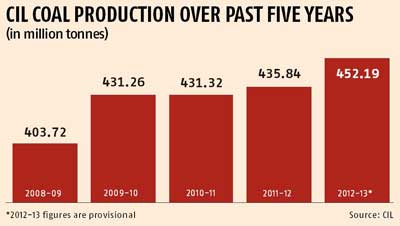
If you thought the government supplied coal to domestic consumers at a significant discount to global rates, think again. State-owned miner Coal India Ltd (CIL) has been selling 18 per cent of its annual 435-mt output at a price higher than, or at least at par with, global benchmarks. The new trend — following a massive decline in global prices, coupled with a rise in domestic rates — has serious ramifications for crucial coal reforms, including price pooling and auction of reserves.

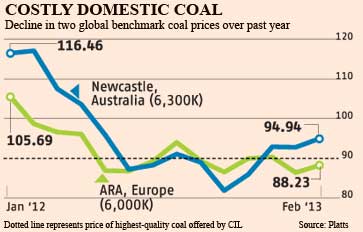
With the global prices of thermal coal recently plunging below CIL’s price of best-quality coal, the traditional price differential between domestic and international rates has been somewhat eliminated. This implies, the impact of the price-pooling mechanism on domestic companies would be less severe. In fact, the narrowing of the gap between domestic and international prices has negated the entire basis of pooling — differential with cost of imports — raising doubts on whether the mechanism is even required.

“The fundamental reason for pooling is to spread the price differential between domestic and imported coal evenly across projects that have coal linkages with CIL. A narrowing gap between the prices voids that assumption and, hence, might alleviate the need for price pooling,” said Dipesh Dipu, partner, Jenissi Management Consultants, an energy- and resources-focused consultancy.

For some projects, depending on their location and coal sources, it might now be economical to solely depend on imports. The Union Cabinet has already given its in-principle approval to pooling. The total cost of imports has been worked out to Rs 72,000 crore by 2017 and the mechanism is expected to lead to a 21 per cent jump in domestic coal prices.

CIL has raised prices five times since deregulation in 2000. The previous price increase, in January 2012, had made domestic coal dearer by an average 12.5 per cent over the Rs 1,600-per-tonne average price prevailing then. This pushed the price of highest-quality CIL coal — with calorific value between 6,700 and 7,000 kilocalorie per kg — to Rs 4,900 per tonne. Following protests, the price was brought down marginally to Rs 4,870 per tonne a month later. This corresponds to $90 per tonne, based on the average rupee-dollar exchange rate of 54 over the past year.

For supplying coal with quality exceeding 7,000 kcal, CIL charges an additional Rs 150 per tonne.

Global thermal coal prices increased consistently, from $25 in early 2000s to a peak of $190 in 2007, primarily owing to a rising demand from China. Thanks to the global meltdown of 2008, prices fell to $120 in January 2012. With the decline continuing over the past year, price of coal traded in the Asian seaborne market have come further tumbling down 29 per cent to under $85 per tonne at present, according to data sourced from Platts, a Singapore-based provider of benchmark energy price assessments. The historic slump of last year occurred as other factors added to subdued Chinese demand.

“Two factors coincided to spark a heavy decrease in spot thermal coal prices. First, a growing oversupply in the market as coal from Colombia and the US, traditionally traded in the Atlantic market, spilled over into the Pacific market. This increased the competition in the Asian market and gave Chinese and Indian buyers a wider range of coal to choose from. Second, a significant number of Chinese buyers suddenly decided in June and July they wanted to renegotiate prices in spot deals. Part of this was due to pressure from the falling domestic prices in China,” Platts Senior Editor Mike Cooper told Business Standard.

For comparison, BS assessed the movement of two global benchmarks — Australian Newcastle harbor and European ARA prices — over the past year. The price graph shows the slump in prices closed the gap between domestic and international rates in June last year. Since then, the global rates have moved largely parallel to the $90-per-tonne mark. In fact, the Australian coal price came down to as low as $78 per tonne in mid-October. However, the average CIL price of Rs 1,600 per tonne is still cheaper than global prices.

CIL attributes the trend to not only a dip in global prices but also the company’s own policy decision that was taken while raising prices in March 2011. “The management had decided to peg coal meant for unregulated customers in the sponge iron and cement sectors closer to international rates. While our prices of A & B quality of coal were still 15 per cent lower than global rates, the slump in global prices in 2012 breached even that 15 per cent differential,” a top CIL said.

Pooling is not the only area facing collateral impact of the new trend. For the auctioning of coal reserves being planned, the erosion of the price differential means applicant companies will have to pay less for winning bids. The floor price of bidding will be based on the “intrinsic value” of a mine which, in turn, will be calculated using either the global benchmark prices or domestic prices offered by CIL. The power ministry has already asked the coal ministry to link the intrinsic value to CIL prices or give 90 per cent discount in case global prices are used as benchmark for calculation.

The new trend will also have a bearing on the future price increases by CIL. While domestic prices are unlinked with global trends, as the government continues to wield control over CIL’s pricing decisions, the globalisation of domestic prices would make CIL’s case for a hike less valid as consumers might switch loyalties.

“For now, CIL may be comfortable to hold on to the current level of pricing for such higher-grade coal. Though, going forward, the international prices seem headed for a rise over next three years. This might give CIL a cushion for a rise,” Dipu said.

Experts also point out that, after taking freight cost into account, CIL’s price might not be much higher than imported coal. Imported coal of the Indonesian origin, with a calorific value of 6,300 kcal, which landed at Vizag port on February 28, was priced at Rs 5,150 per tonne ($81 free on board, plus $11 freight cost), according to data sourced from resources research firm Oreteam. For comparison, CIL sells equivalent-quality coal at Rs 3,970 per tonne. With a freight cost ranging between 10 per cent and 15 per cent, the total cost of this coal goes up to Rs 4,370 per tonne.

If, as expected, prices go up later this year, the new trend of a diminishing gap in domestic and global prices might not last. However, it might have had done enough damage by delaying crucial reforms

Zambia criticizes Vedanta for not generating enough jobs - Quoted in the Mint

The Zambian government has criticized Vedanta Resources Plc, the London-listed mining company controlled by Indian-born billionaire Anil Agarwal, for failing to generate employment commensurate with the size of its investment in the southern African country.
 
Vedanta made the single largest investment by a company in Zambia of $2.6 billion (around Rs.14,144 crore today). It acquired a majority stake in Konkola Copper Mines Plc (KCM), an integrated copper producer, in 2004. Zambia is among the world’s leading exporters of copper. India’s imports from the country include non-ferrous metals such as copper and cobalt.
 
“Ideally, Vedanta wouldn’t really be worried about Zambian employment levels as it is not their issue,” Zambian vice-president Guy Scott said in an interview on 19 March. “But we are pressurizing them to worry about exactly that. There is a concern that there is a disconnect between investment and employment.”
 
The vice-president was in Delhi to attend the recently concluded Confederation of Indian Industry-Exim Bank Conclave on India-Africa Project Partnership in New Delhi.
 
Questions emailed to spokespersons for Vedanta Resources and KCM on Friday remained unanswered till press time on Wednesday.
 
To be sure, according to information available on KCM’S website, the company is Zambia’s largest private sector employer with around 22,000 permanent and contract employees, although Scott insisted that Vedanta hasn’t gone far enough in creating jobs.
 
In Zambia, the problem is of striking a balance between the development of the local population in terms of creating sufficient employment opportunities and promoting mining interests, Scott said.
“I mean Vedanta had it in India itself. You have been facing problems with the tribal areas. You have been facing problem with the environment,” he said. “You know mining is intrinsically not automatically good for everybody. So, we have some issues there. On the other hand, we can’t not mine because that’s really what we are good at or what we have the resources to do.”
 
Dipesh Dipu, a partner at Jenissi Management Consultants, a Hyderabad-based resources-focused consultancy, referred to the “resource curse”, which suggests that mineral-rich countries and states don’t necessarily benefit to the extent that they expect to and mining-affected people continue to get marginalized.
 
“Localization of jobs and contracts have been targeted by policy interventions in most cases by the governments. Several mining companies too have begun to emphasize on social licence to operate and have strived to address the concerns of local population and regional economic development through employment and support to entrepreneurs,” Dipu said.
 
“However, political outcry for resource nationalism in several geographies indicate that these measures have had limited success till now. Greater accountability and transparency in distribution of economic benefits are the key,” he said.
 
Scott said the government wanted the mining company to farm out more work locally such as “secondary manufacturing steel poles, eucalyptus poles and maintenance and repair”. Scott said Vedanta was not doing “enough of it”.
 
Zambia’s demand comes in the backdrop of India seeking access to minerals in resource-rich Africa to fuel its growing economy.
 
India’s push for resources has pitted it against China, a contest in which it has usually been bested.
However, copper demand growth in India is expected to slow to about 6-7% this fiscal year from 8% on a compounded basis in the last 10 years, while prices of the metal are expected to be stable as a slowing world economy and China’s dulled appetite for metals has affected copper prices.
 
According to the Bank of Zambia, with a population of 13.11 million, the country has a real gross domestic product growth of 7.3%.
 
The country, with a per capita gross domestic product of $377 in 2012 and also has inflation running at the same pace—7.3%.

Power, fertilizer ministries may oppose increase in gas price - Quoted in the Mint

The government may not be able to raise the prices of natural gas as much as it wants to because the fertilizer and power ministries have reservations on the recommended pricing formula.
The proposed freeing of gas prices and a resultant increase will directly benefit local producers such as Mukesh Ambani-led Reliance Industries Ltd and state-owned Oil and Natural Gas Corp. Ltd and Oil India Ltd.
 
A panel led by C. Rangarajan, the Prime Minister’s economic adviser, in December suggested a system that would price the fuel at $8-8.5 per million metric British thermal units (mmBtu). This compares with the current domestic prices that range between $3.5 and $5.73 per mmBtu. Imported natural gas costs around $14.17 per mmBtu.
 
Finance minister P. Chidambaram said in his budget presentation on 28 February that the government will review its pricing policy on natural gas and remove uncertainties in this regard.
 
The fertilizer ministry may object to the Rangarajan formula and instead suggest the fuel be priced at around $6 mmBtu, according to three ministry officials who spoke on condition of anonymity. A final view, however, has not yet been taken, they said.
 
“We are yet to respond to the note (on the Rangarajan formula that has been circulated among the relevant ministries). High gas prices would have to be passed on to consumers, in this case state electricity boards, who are already finding it difficult to purchase power,” a power ministry official said. “We are not in favour of high prices and will respond accordingly.”
 
Another official in the power ministry also expressed reservations over the recommended pricing mechanism. Both officials declined to be named.
 
The views of these two ministries are important because the sectors they oversee are the largest consumers of natural gas in the country.
 
The fertilizer ministry’s likely view will be more representative of global prices than what has been suggested by the Rangarajan panel, according to Dipesh Dipu, a partner at Jenissi Management Consultants, a Hyderabad-based resources-focused consultancy.
“However, it will definitively have a negative impact on the future profitability of gas suppliers,” Dipu said.
 
Sudhir Vasudeva, chairman and managing director of ONGC, and S.K. Srivastava, chairman and managing director of Oil India, did not respond to phone calls or messages sent to their mobile phones. Queries emailed on Monday to a Reliance Industries spokesperson remained unanswered.
The Rangarajan panel had, in its December report, indexed the price of domestically produced gas to prices prevailing in the international market, effectively recommending the freeing of gas prices in India and scrapping the administered pricing mechanism (APM).
 
It suggested a formula in which the final base price was arrived at by the simple average of the respective weighted averages of the prices of imported gas across sectors over a 12-month period and that of prices in the three major international gas trading hubs. These are the US Henry hub, the UK National Balancing Point and Japan’s custom-cleared rate.
 
The cost of imported gas was calculated on the basis of the so-called netback mechanism, in which transport and liquefaction costs are subtracted from the landed price of gas to arrive at the implied base price.
 
The fertilizer ministry is of the opinion that instead of a simple average, the final price should be arrived at by a weighted average of the two respective weighted averages themselves.
 
“Since domestic gas is the country’s natural resource, with a social objective, its price cannot be indexed to external prices. Domestic gas prices in various countries including the Middle East and Africa are extremely economical even today,” said one of the fertilizer ministry officials cited earlier. “But, if the government does want to index it to global prices, the formula suggested by the fertilizer industry is better as it keeps the final base price in check.”
 
The matter of natural gas from domestic sources priced in dollars and not rupees has also been raised in the parliamentary standing committee on fertilizers, Mint reported on 12 December.
 
There are four major pricing regimes for domestic gas in India—under APM, non-APM, pre-new exploration licensing policy (Nelp) and Nelp. The government allocates rights to explore fields through bidding under Nelp, which started in January 1999.
 
Currently, APM and Nelp gas are priced at $4.2 per mmBtu, with gas from pre-Nelp blocks costing between $3.5 and $5.73 per mmBtu. The prevailing basic price of imported gas is around $14.17 per mmBtu. The price of gas produced at Reliance Industries’ deepwater KG-D6 field off the east coast has been fixed at $4.2 per mmBtu till 2014.
 
India’s power and fertilizer sectors have a demand of 135 million standard cu. m per day (mscmd) and 62 mscmd, respectively. This is expected to reach 171 mscmd and 113 mscmd, respectively, in 2014-15, according to the petroleum ministry.

Finance ministry, Plan panel oppose coal price pooling - Quoted in the Mint

The finance ministry and the Planning Commission support the coal ministry’s view that the government should reject a plan that seeks to sell coal to power plants at a uniform price by taking a weighted average cost of the fuel from local and imported sources, according to coal secretary S.K. Srivastava.
 
The ministry and Coal India Ltd are of the opinion that the fuel should be imported on a so-called cost-plus basis and the incremental power-generation costs should be passed on to the end-consumer by the electricity producers. If implemented, the plan could lead to a significant rise in the cost of power generation in the country.
 
The coal secretary’s statement is significant considering the fact that on 6 February, the cabinet had given an in-principle approval to pooling coal prices. The cabinet had, however, asked the coal and power ministries to come back with specifics on the proposal. Srivastava was speaking on the sidelines of an inter-ministerial panel on coal linkages.
 
A cost-plus price is determined after factoring in the desired profit over and above the full cost of a commodity. Price pooling, on the other hand, refers to the sharing of costs, in part or in full, by the users of a certain commodity. In effect, the commodity gets a uniform price throughout a region.
 
The government has been debating the issue of coal price pooling to bring uniformity in prices, since the financial viability of power plants fuelled by imported coal has been affected because the price of the fuel has exceeded projections.
 
Coal price pooling will see power tariffs rise by as much as 13 paise a unit, Mint reported on 6 February.
 
According to the earlier proposal discussed at a February cabinet meeting, till local coal production meets the country’s demand, only those power projects located near the coast and featured on a Central Electricity Authority list will be eligible to benefit from the proposed pooling of coal prices. Price pooling could increase the cost of coal by Rs.90-100 per tonne.
 
The power ministry declined to comment on the matter. “The issue is before the cabinet. The coal ministry can propose this issue to them. The idea of coal pooling was thought of as there were no better options available. We are open to any good option,” said a power ministry official, requesting anonymity.
 
If the government does agree to the coal ministry’s view, the cost of power generation will go up significantly, said Dipesh Dipu, an energy analyst and a partner at Jenissi Management Consultants. If a producer generates electricity at Rs.2.50-3.20 per unit when coal prices are pooled, it would increase to Rs.3.50 per unit for consumers, Dipu said.
 
“Power producers who procure imported coal would find it hard to sell costlier electricity to state distribution companies,” he said. “Private companies most affected would be the ones who have set up plants near the coast. Having said that, one assumes that they would have factored in all the risks,” he said.
 
A top Coal India executive, who did not want to be identified, said the company had never favoured coal price pooling. “Either ways, however, it does not impact us. We remain no more than a clearing house,” the executive said.

Budget 2013: Govt eyes more investments in energy sector - Quoted in the Mint

Electricity generated from imported coal will become costlier by around 3.5 paise a unit after finance minister P. Chidambaram on Thursday removed duty concessions granted in last year’s budget.
Instead, he imposed an equal duty on different types of coal imported for electricity generation in the budget for 2013-14. This follows an increase in railway freight rates for coal announced on Tuesday.
However, to attract investments to energy projects that are capital-intensive, such as power generation plants and hydrocarbon blocks, the budget allowed for deduction of investment allowance of 15% on investments of Rs.100 crore or more in plant and machinery during the next two fiscal years of 2013-14 and 2014-15. This is in addition to depreciation benefits. Currently, no such investment allowance deduction is available.
 
“Steam coal is exempt from customs duty but attracts a concessional CVD (countervailing duty) of 1%. Bituminous coal attracts a duty of 5% and CVD of 6%. Since both kinds of coal are used in thermal power stations, there is rampant mis-classification. I propose to equalize the duties on both kinds of coal and levy 2% customs duty and 2% CVD,” Chidambaram said in his budget presentation.
 
Mint reported on 19 February about a proposed clarification on coal imports meant for electricity generation that would resolve the confusion resulting in Indian customs authorities denying importers fuel duty concessions granted in last year’s budget. “The impact may be incremental now that prices are subdued from recent peaks, but will make it more expensive as international prices may be heading for a rise going by the forward-market transactions,” said Dipesh Dipu, a partner at Jenissi Management Consultants, a Hyderabad-based resources-focused consultancy.
 
India is facing a chronic fuel shortage. In such a scenario, imports hold the key. The size of the market for imported coal that goes into power generation in India is around 80 million tonnes per annum (mtpa).
 
India will need to import 185 million tonnes of coal in 2016-17, which may further add to the financing cost of power projects.
 
“It wouldn’t impact us as fuel costs are a pass through to the customers. We expect the overall increase in electricity tariff due to railway freight hike and today’s announcement to be around 5 paise,” said Arup Roy Choudhury, chairman and managing director of NTPC Ltd, India’s largest power generation utility with a capacity of 40, 174 MW. The government plans to devise a public-private partnership (PPP) policy framework with Coal India Ltd to attract the private sector as partners to increase the domestic coal production.
 
In addition, the budget also extended a tax holiday under section 80-IA of the Income-Tax Act for power projects, which ends on 31 March, by another year and announced a generation-based incentive for wind-energy projects to discourage investments aimed at availing tax concessions.
The government will also spend Rs.1,840 crore for connecting the Ladakh region to the northern region electricity grid. To promote other environment-friendly energy projects, the government will also provide low-interest-bearing funds to the Indian Renewable Energy Development Agency for lending. Noting that the country tosses out several thousand tonnes of garbage each day,
Chidambaram said the government will evolve a scheme to encourage cities and municipalities to take up waste-to-energy projects in the form of public-private partnerships, employing different technologies.
 
Waste-to-energy plants, however good an idea, have not worked in the country, according to Sunita Narain, director general of Centre for Science and Environment, a Delhi-based environment advocacy institute.
 
To arrest rapidly diminishing interest in the Indian hydrocarbon sector, the budget announced a move towards a revenue-sharing model from a profit-sharing one in calculating the share of earnings that operators of oil and gas block have to pay it. This is in line with the recommendations of the Rangarajan committee on formulating new production-sharing contracts.
 
“Revenue share replacing profit share will help investors not get subjected to cost scrutiny and likes of CAG (Comptroller and Auditor General) audits,” said Deepak Mahurkar, leader, oil and gas, PwC India, a consultancy. “However, withdrawal of the cost-recovery mechanism exposes investors to more risks and that may dissuade large oil companies from India.”
 
“Although this announcement removes certain uncertainties in terms of capital cost padding, it brings in additional complication of industry not attracting risk capital,” said Debasish Mishra, senior director at Deloitte Touche Tohmatsu India Pvt. Ltd, an audit and consutancy firm.
 
This comes in the backdrop of the petroleum ministry’s proposal to deny Reliance Industries Ltd $1.24 billion in costs for the deepwater KG-D6 fields for 2010-11 and 2011-12.
 
“The natural gas pricing policy will be reviewed and uncertainties regarding pricing will be removed,” Chidambaram said.
 
“A key next step should be the transition of prices of domestic natural gas to import parity in the next three years, similar to the diesel price reforms,” said Sashi Mukundan, regional president and head of country, BP India, an oil firm.

Power generation from imported coal to become costlier - Quoted in the Mint

Generating electricity from imported coal will become costlier as finance minister P. Chidambaram on Thursday removed duty concessions granted in last year’s budget.

Instead, he imposed an equal duty on different types of coal imported for electricity generation in the budget for 2013-14.
 
Under the Customs Tariff Act, the fuel has been classified as anthracite, bituminous, coking and steam coal. While steam coal is only used for electricity generation, most bituminous coal is used for power generation and can also be used to produce sponge iron and as a partial substitute for metallurgical coal.
 
“Steam coal is exempt from customs duty but attracts a concessional CVD (countervailing duty) of 1%. Bituminous coal attracts a duty of 5% and CVD of 6%. Since both kinds of coal are used in thermal power stations, there is rampant mis-classification. I propose to equalize the duties on both kinds of coal and levy 2% customs duty and 2% CVD,” Chidambaram said in his budget presentation.
 
The issue stems from the interpretation of the exemption, which was granted to steam coal. Customs authorities have taken the view that the coal being imported for power generation is not steam coal, but bituminous and, therefore, liable for higher duty than the concessional duty of 1% announced in last year’s budget.
 
The budget may announce a clarification on coal imports meant for electricity generation that would resolve the confusion resulting in Indian customs authorities denying importers of the fuel duty concessions granted in last year’s budget, Mint reported on 19 February. This comes in the backdrop of customs authorities issuing notices to companies importing coal.
 
“The impact may be incremental now that prices are subdued from recent peaks, but will make it more expensive as international prices may be heading for a rise going by the forward-market transactions,” said Dipesh Dipu, a partner at Jenissi Management Consultants, a Hyderabad-based resources-focused consultancy.
 
India is facing a chronic fuel shortage. In such a scenario, imports hold the key. The size of the market for imported coal that goes into power generation in India is around 80 million tonnes per annum (mtpa).
 
Coal demand in India is expected to grow from 649 mtpa now to 730 mtpa in 2016-17. The availability of local coal is estimated at 550 mt in 2016-17, with the shortage largely expected to be met through imports. India’s demand for imported coal is growing and stands at an annual 137 mt.
 
Underlining the need for increasing the domestic production of coal, Chidambaram said, “Despite abundant coal reserves, we continue to import large volumes of coal. Coal imports in April-December 2012 have crossed 100 million tonnes. It is estimated that imports will rise to 185 million tonnes in 2016-17. If the coal requirements of the existing power plants and the power plants that will come into operation by 31 March 2015 are taken into account, there is no alternative except to import coal and adopt a policy of blending and pooled pricing. In the medium to long term, we must reduce our dependence on imported coal. One of the ways forward is to devise a public-private partnership (PPP) policy framework, with Coal India Ltd as one of the partners, in order to increase the production of coal for supply to power producers and other consumers.”
 
“The PPP mode also has an element of auction, but it is a better method of auction as for the private partner it speeds up processes of clearance at government level due to presence of Coal India. For Coal India, it opens up the trading route in a limited manner,” said Kameswara Rao, executive director and leader of energy, utilities and mining practice at audit and consulting firm PricewaterhouseCoopers Pvt. Ltd.